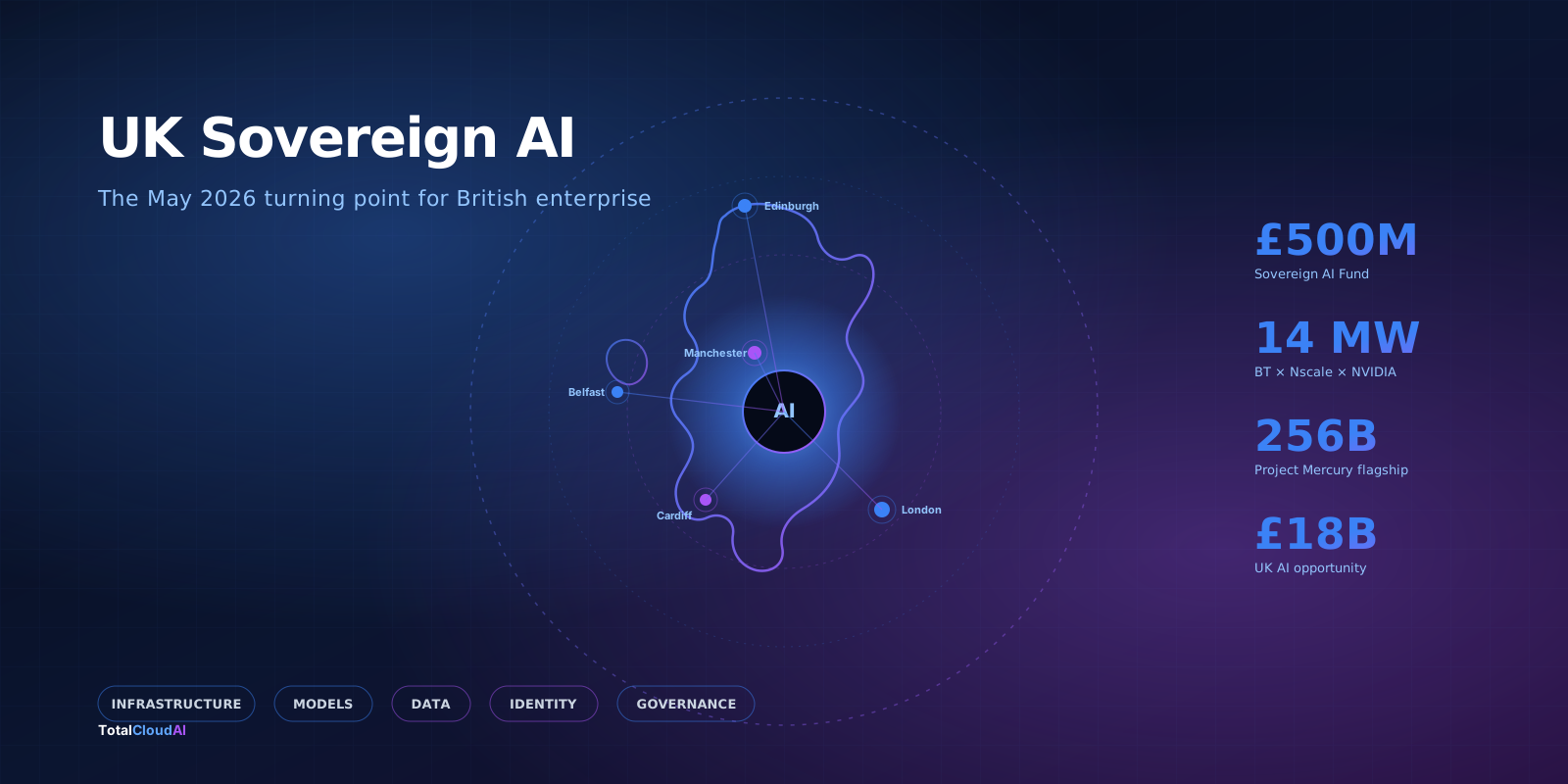
For a decade, the UK has been what one minister bluntly called a “digital tenant”: a country that uses world-class cloud and AI services, but rents them, on terms set elsewhere. In May 2026, that posture is changing — and not gradually. In the space of a few weeks, the British state, telecoms incumbents, the GPU supply chain, the regulator, and a wave of homegrown start-ups have together drawn a new map of where AI runs, who governs it, and on whose terms.
For enterprise leaders, this is not abstract policy. It changes how regulated workloads are architected, how procurement teams write AI clauses, where models can legally be fine-tuned, and which providers can credibly handle Tier-1 data. This article unpacks what has just happened, what it means, and how to build a sovereign AI posture without ripping out everything that already works.
1. What “Sovereign AI” Actually Means
Sovereign AI is often reduced to a slogan about data staying in-country. The full picture is wider. It is the principle that the compute, models, data, and governance behind an organisation's AI systems remain under jurisdictions, ownership structures, and operational controls that the organisation — and the country it operates in — can defend.
That breaks down into five practical pillars. An AI capability is only as sovereign as its weakest pillar.
This matters because the failure modes are different in each pillar. A UK-resident SaaS that calls a US-owned foundation model over the public internet has data sovereignty without model sovereignty. A privately-hosted open-weights model running on infrastructure controlled by a foreign cloud has model sovereignty without infrastructure sovereignty. Genuine sovereign AI is an end-to-end property, not a label on the front door.
2. The May 2026 UK Sovereign AI Timeline
Several independent threads have converged in a remarkably short window. Together, they shift the British AI landscape decisively away from default reliance on US hyperscalers.
Project Mercury launches
14 April 2026Locai Labs and Civo unveil the UK's first family of fully pre-trained sovereign frontier models — from 0.8B-parameter edge models up to a 256B-parameter flagship — hosted on Civo's UK-resident sovereign cloud and powered by 100% renewable energy.
UK £500M Sovereign AI Fund opens for procurement
20 April 2026DSIT opens market engagement on a first £80M tranche from the £500M Sovereign AI Capability Fund, with 12–24 month contracts up to £5M per project across health, defence, cyber, energy and public services. Crucially, bidders retain background and foreground IP.
BT × Nscale × NVIDIA sovereign data centres
23 April 2026BT and Nscale announce up to 14 MW of sovereign AI data centre capacity across three existing BT sites, on NVIDIA's full-stack AI infrastructure. The three companies are founding members of the new UK Sovereign AI Industry Forum.
CMA opens investigation into Microsoft
May 2026The Competition and Markets Authority begins assessing whether Microsoft warrants a Strategic Market Status designation over its combined cloud and AI position — the most consequential UK competition review of a hyperscaler to date, with knock-on effects for procurement clauses across the FTSE.
DSIT procurement contact deadline
16 May 2026Companies pitching into the first sovereign AI procurement round must register interest. The full competition is expected to launch by July 2026, setting the tone for sovereign AI buying behaviour across regulated UK sectors for the next two years.
The UK's addressable AI opportunity is now estimated at £18 billion. The country that hosts, trains, and governs those workloads will keep most of the value.
3. Why Now: The Three Forces Behind the Shift
This is not a sudden change of heart. Three pressures have been compounding for years and have now hit at once.
Regulatory pressure
The FCA's expanding expectations on third-party risk and operational resilience, the ICO's renewed scrutiny of automated decision-making, the EU AI Act's extraterritorial reach into UK firms with European exposure, and now the CMA's SMS review of Microsoft together create a regulatory environment where “our AI provider is a US hyperscaler” is no longer a sufficient answer. Boards are being asked to evidence not just where data is, but who could be compelled to disclose it.
Geopolitical risk
The CLOUD Act, evolving US export controls on advanced chips, and the volatility of trade relationships all introduce non-technical risks into AI architectures. For a UK defence contractor, NHS trust, or critical-national-infrastructure operator, the question is no longer abstract: can a foreign government compel our AI provider to act against our interest? Sovereign architectures answer that question structurally rather than contractually.
Economic gravity
The UK has world-class AI research, a deep financial services market, and one of the largest pools of regulated data in Europe. Continuing to ship that data abroad for inference means continuing to ship the margin abroad. The £500M Sovereign AI Fund, Project Mercury, and the BT/Nscale data centre build are an explicit attempt to keep more of the AI value chain — and the jobs — on UK soil.
4. The Sovereign AI Stack: Anatomy of a UK-Resident Architecture
A working sovereign AI architecture is a layered stack. Each layer has both a hyperscaler-default option and an increasingly credible UK-sovereign option. The right architecture for most enterprises in 2026 mixes the two deliberately.
Policy-as-code, model cards, AI risk register, regulator-ready audit trails.
Copilots, internal agents, RAG systems, customer-facing AI experiences.
Mercury Series, open-weights LLMs, plus selectively-used hyperscaler models.
UK-resident lakehouse, lineage, RBAC, encryption with customer-held keys.
UK-anchored IdP, zero-trust connectivity, sovereign egress controls.
Civo Sovereign Cloud, BT/Nscale GPU capacity, UK regions of AWS / Azure / GCP, on-prem GPU.
The mistake we see most often is treating sovereignty as an all-or-nothing switch. In practice, the optimal architecture for most UK enterprises is a deliberate split: regulated and high-sensitivity workloads on a fully sovereign stack, mainstream productivity and ML workloads on hyperscaler UK regions with strong contractual controls, and a clean policy boundary that prevents one drifting into the other.
5. Why This Matters for Your Enterprise — Three Scenarios
Financial services: model risk meets concentration risk
The PRA's growing focus on third-party concentration risk, combined with the CMA's Microsoft review, means UK banks and insurers face a real question: what does our AI estate look like if we are required to demonstrate viable alternatives to any single hyperscaler? A sovereign AI tier — even if it only initially serves model fine-tuning, sensitive RAG over customer records, and high-risk decisioning — turns a board-level concentration risk into a board-level resilience story.
Healthcare and life sciences: where data simply cannot leave
NHS Digital's Data Security and Protection Toolkit, the proliferation of confidential patient information rules, and the unique sensitivity of genomics data make healthcare the clearest fit for sovereign AI. The release of Mercury Series edge models specifically targeted at on-premise deployment changes what is feasible: an NHS trust can now run a domain-tuned model entirely inside its own boundary, with no inference traffic crossing a public network.
Defence, government, and critical national infrastructure
For these sectors, sovereignty has always been mandatory but options were thin. With BT's sovereign platform extended via Nscale and NVIDIA, and the £500M Sovereign AI Fund actively procuring capability in defence, cyber, and national security, sovereign AI is moving from bespoke programmes into a repeatable architecture. For tier-2 and tier-3 suppliers into these primes, “can you operate sovereign-mode?” is becoming a pre-qualifier rather than a differentiator.
6. A Four-Phase Sovereign AI Adoption Roadmap
Most enterprises do not need a sovereign-only strategy — they need a sovereign-capable one. The pattern that works, drawn from our engagements across financial services, healthcare, and the public sector, is a four-phase build.
Map & Classify
Weeks 1–4Inventory every AI workload, its data class, the model it depends on, and where inference physically happens. Score each against the five sovereignty pillars. You will almost always find at least one workload that should not have been routed offshore.
Define the Sovereign Tier
Months 2–3Decide which workloads belong on a sovereign tier and pick the architecture: Civo Sovereign Cloud, BT/Nscale GPU capacity, on-prem appliance, or a Mercury-Series edge deployment. Write the policy that prevents drift back to the hyperscaler default.
Migrate the First High-Value Workload
Months 3–6Pick a workload that is regulated, valuable, and tractable — usually a RAG system over sensitive internal data, or a domain-tuned model for risk, claims, or clinical use. Build it end-to-end on the sovereign tier with full audit, key management, and IP retention.
Operate, Govern, Expand
OngoingEstablish a sovereign AI control plane: model registry, AI risk register, evidence pack for the FCA / ICO / NHS DSPT / MoD as appropriate. Then expand the tier deliberately — one workload class at a time — rather than ripping out the hyperscaler estate.
7. Where TotalCloudAI Helps
This is the practical heart of the article. TotalCloudAI is a UK-based, certified multi-cloud consultancy with deep AI engineering and regulated-industry experience — precisely the profile this market shift rewards. Here is how each of our services maps directly to the work UK enterprises need to do now.
Sovereign AI Readiness Assessment
A structured four-week engagement that inventories every AI workload, classifies it against the five sovereignty pillars, scores concentration and data-residency risk, and produces a board-ready sovereign AI posture report.
Service: Cloud Strategy & AI/ML Consulting
Sovereign Architecture Design
Reference architectures combining Civo Sovereign Cloud, BT/Nscale GPU capacity, UK regions of Azure/AWS/GCP, and on-prem deployment of Mercury Series and open-weights models — with the policy guardrails that prevent drift.
Service: Cloud Infrastructure & AI/ML Consulting
Workload Migration & Re-platforming
Hands-on engineering to move regulated workloads from foreign-controlled inference paths onto a sovereign tier, with zero-loss data lineage, key migration, and observability parity from day one.
Service: Cloud Migration & Managed Cloud
AI Governance & Assurance
Policy-as-code, model registry, AI risk register, and the evidence packs the FCA, PRA, ICO, NHS DSPT, and MoD-aligned frameworks will increasingly demand. Built once, reused across every audit.
Service: Security & Compliance
DevOps for Sovereign AI
CI/CD, IaC, model deployment pipelines, and observability stacks that work identically across sovereign and hyperscaler tiers — so engineering velocity is not the price of sovereignty.
Service: DevOps Automation
Ongoing Managed Service
24×7 operation of the sovereign AI tier — patching, scaling, incident response, drift detection — under UK contracts, with UK-based engineers, audited to the standard your regulator expects.
Service: Managed Cloud & Backup / DR
We are platform-neutral by design. We will recommend a hyperscaler when that is the right answer, a sovereign provider when that is, and almost always a deliberate hybrid — documented, governed, and built so that the boundary between the two cannot quietly erode over time.
8. Five Questions to Take Into Your Next Board Meeting
If sovereign AI has not yet been a board agenda item, the events of May 2026 are the cue. A useful starting set of questions:
- Where, physically and legally, does each of our AI workloads run today? If no one in the room can answer this in under thirty seconds, the inventory work is overdue.
- Which workloads carry data we would not be comfortable seeing in a foreign subpoena response? Those are the workloads that belong on a sovereign tier first.
- What is our exposure to a single-hyperscaler concentration finding from the CMA or PRA? Even if no finding lands, the question itself is now standard in board-level operational resilience reviews.
- Are we positioned to bid into the £80M DSIT procurement round — or to supply someone who is? The IP-retention terms make this a genuinely attractive route for British AI capability.
- Who owns the sovereign AI roadmap inside the organisation? If the answer is “no one yet,” the next twelve months will be more expensive than they need to be.
Conclusion: The Quiet Re-architecture Has Begun
None of the events of spring 2026 are individually decisive. A fund. A start-up. A data centre deal. A regulatory review. Taken together, however, they signal something larger: the UK has decided to stop being a digital tenant and to build, host, and govern enough of its own AI to set the terms of its use. For enterprises, the implication is not panic — it is intent. Sovereign AI does not require abandoning the hyperscalers. It requires deciding, deliberately, which workloads belong where, and building the architecture, evidence, and operational muscle to defend that decision.
The window in which sovereign AI is a competitive advantage is open now and will not stay open indefinitely. Within twelve to eighteen months, “can you operate a sovereign tier?” will be a baseline procurement question from regulators, customers, and primes. The enterprises that begin the build today will be answering it from a position of strength — and the ones that wait will be answering it under pressure.
If you would like to talk through what a sovereign AI posture looks like for your organisation, our certified architects across Azure, AWS, GCP, and the UK sovereign providers are happy to scope a short readiness assessment with you.
Get the UK Sovereign AI Readiness Checklist
A 12-point self-assessment covering data residency, model provenance, key management, concentration risk, audit evidence, and procurement readiness. Score your organisation and identify gaps before your next board review.