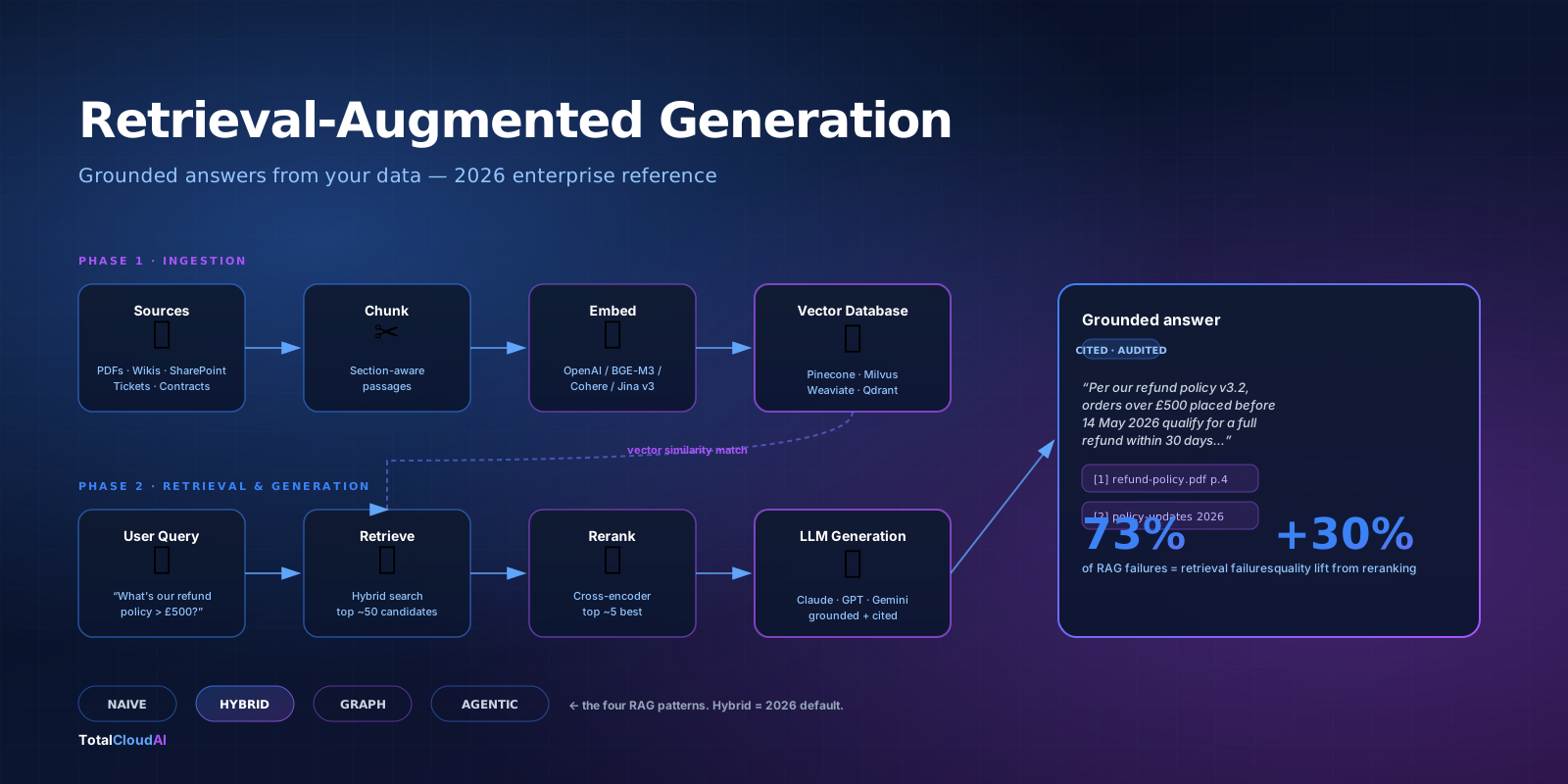
If you have ever asked a chatbot a specific question about your business — your refund policy, your contract terms, your internal procedures — and received an answer that sounded confident but was wrong, you have already experienced the limit of vanilla large language models. They are trained on a frozen snapshot of the public internet. They have never seen your documents. And when asked about them, they will often invent something that sounds right.
Retrieval-Augmented Generation (RAG) is the architectural fix. It puts your trusted knowledge between the user's question and the model's answer, so the response is grounded in your data and traceable to a source. In 2026, RAG is the default pattern behind nearly every credible enterprise AI deployment — internal knowledge assistants, customer-support copilots, document intelligence systems, domain expert tools. This guide is the full picture: what it is, how it works, the patterns, the stack, the costs, the mistakes, and how to actually ship one.
1. What Is RAG — In Plain Terms
A standard chatbot answers from memory. A RAG system looks things up first, then answers. That single shift — from generation-only to retrieve-then-generate — changes everything about how the resulting system behaves: it gets more accurate, more current, more verifiable, and able to reason over data the model never saw during training.
The mechanics are simpler than the acronym suggests. A user asks a question. The system finds the most relevant passages from your knowledge base, slips them into the prompt as context, and asks the language model to answer using that context. The answer is grounded in retrieved facts, and the system can show its citations.
Why RAG matters — the five-second version
Current · Accurate · Auditable · Private-data-aware · Cheaper than fine-tuning. Updates require ingesting new documents, not retraining a model. Compliance teams can see exactly which source produced which answer. Your data stays inside your cloud boundary. That combination is why RAG, not fine-tuning, has become the default enterprise pattern.
2. How RAG Works: The Two-Phase Flow
Every RAG system runs in two phases. The first happens once when you set up the system and again whenever your documents change. The second happens on every user query.
PHASE 1 Ingestion (one-off & on update)
PHASE 2 Retrieval & Generation (every query)
Notice that the model itself is the last step, not the first. This is the most important and least appreciated fact about RAG: the quality of the system is overwhelmingly determined by what happens before the model is called.
3. The Four RAG Architecture Patterns
There is no single “RAG.” There is a spectrum of architectures, and the right one depends on accuracy needs, data complexity, and budget. We select deliberately rather than over-engineering — the wrong pattern doubles the cost and barely moves accuracy, while the right pattern often costs less than the demo you were sold.
Naive RAG
The core load → chunk → embed → retrieve → generate pipeline with vector similarity search. The starting point.
Best for: Prototypes, FAQs, single-source Q&A
Hybrid RAG
Combines dense (semantic) embeddings with sparse (keyword) search, plus a reranking layer. The current enterprise baseline.
Best for: Most production deployments
Graph RAG
Adds a knowledge-graph layer for multi-hop, relationship-based reasoning across connected data and entities.
Best for: Connecting facts across documents
Agentic RAG
An autonomous agent plans, decomposes queries, routes to multiple tools and indexes, evaluates results, and iterates until confident.
Best for: Multi-part, ambiguous, cross-source
Hybrid retrieval has become the consensus enterprise strategy in 2026 — reporting indicates enterprise intent to adopt it roughly tripled in a single quarter. Graph and Agentic patterns deliver more reasoning power but cost more (knowledge-graph extraction can run 3–5× the baseline), so we apply them only where the reasoning depth justifies the spend.
4. RAG vs Fine-Tuning vs Prompt Engineering
The single most common question in RAG scoping conversations is “why not just fine-tune the model?” The honest answer is that fine-tuning, RAG, and prompt engineering are different tools for different problems, and you often need a mix. The decision table below is the one we use when scoping.
| Prompt engineering | RAG | Fine-tuning | |
|---|---|---|---|
| Adds new facts? | No | Yes — from your data | Yes — baked in |
| Updates when data changes? | Manual | Re-ingest documents | Retrain |
| Auditable citations? | No | Yes | No |
| Cost to update | Trivial | Low (ingestion only) | High (compute + data prep) |
| Changes model behaviour/style? | A little | No | Yes |
| Time to first version | Hours | Weeks | Months |
| Best for | Tone, format, simple rules | Knowledge, search, support | Specialised style/skill |
In practice, the typical enterprise system uses all three: prompt engineering to set tone and structure, RAG to ground answers in your data, and (rarely) fine-tuning to specialise the model's style or fluency in a narrow domain. RAG is almost always the right answer for any system that needs to know things about your business.
5. The Production RAG Tech Stack
A production RAG system is assembled from a few interchangeable layers. We choose components per project based on data sensitivity, scale, latency, and cost — and we work across both managed and open-source options on Azure, AWS and GCP.
RAGAS-style faithfulness & relevance scoring, precision@k / recall@k, prompt & response logging.
Claude, GPT, Gemini, or open-weight models — chosen for accuracy, cost and data-residency.
Cohere Rerank, BGE rerankers — cross-encoders that pick the top ~5 from ~50 candidates.
Pinecone, Milvus, Weaviate, Qdrant for production; Chroma, FAISS for prototypes.
OpenAI text-embedding-3-large, BGE-M3, Cohere Embed, Jina v3 — chosen for quality & cost.
LangChain / LangGraph, LlamaIndex — wire loaders, chunkers, retrievers, and agentic loops.
A typical high-quality pipeline retrieves the top ~50 candidates with hybrid search, reranks down to the top ~5, and passes those to the LLM — a step that consistently improves answer quality by 15–30% on standard evaluation metrics. The reranker is the single highest-ROI addition you can make to a baseline RAG system, and it is the upgrade we most often inherit projects without.
6. How TotalCloudAI Delivers RAG: A Six-Phase Engagement
We follow a pragmatic, build-measure-improve methodology: get a working end-to-end pipeline first, then optimise retrieval against real metrics rather than guesswork. Every phase has a tangible outcome, and you can stop at the end of any phase if value is not appearing.
Discovery
Outcome: scope, metrics, architectureHalf-day to a week. We map the use case, data sources, users, accuracy bar, and compliance constraints. We pick the right RAG pattern for the problem — not the most impressive one.
Data Foundation
Outcome: clean, governed knowledge baseConnect sources, design chunking, attach metadata, set access controls, build the ingestion pipeline. Most RAG projects that go wrong, go wrong here.
Baseline Pipeline
Outcome: working system & metric baselineStand up an end-to-end RAG flow. Measure retrieval (precision@k, recall@k) and answer quality (faithfulness, relevance). You now have a known starting point to improve against.
Optimisation
Outcome: target accuracy reachedAdd hybrid search, reranking, prompt tuning. Add graph or agentic layers only where the data justifies them. Iterate against the metrics from Phase 3 — not against opinions.
Productionise
Outcome: reliable, observable, scalableMonitoring, evaluation pipelines, security hardening, scaling, and CI/CD on Azure / AWS / GCP. Identity governance and audit trails wired in from day one.
Operate & Improve
Outcome: sustained quality over timeContinuous evaluation, scheduled content refresh, ongoing tuning as data and usage evolve. RAG systems that are not actively maintained get worse, not better.
7. The Five Mistakes That Derail Most RAG Projects
The reason most enterprise RAG pilots underperform is not the model and not the framework — it is the same five issues, again and again. If you are starting (or rescuing) a RAG project, this is the list to check against first.
- Chunking the wrong way. Fixed-size character chunking destroys semantic units. Use document-aware chunking that respects headings, sections, and table boundaries — this single change often beats every other “advanced” tactic.
- Skipping the reranker. A baseline pipeline that retrieves and passes its top 5 straight to the model leaves 15–30% of accuracy on the table. A cross-encoder reranker is cheap, fast, and the highest-ROI add we know.
- No evaluation framework. Without precision@k, recall@k, and faithfulness scoring, you cannot tell whether last week's “improvement” helped or hurt. Evaluation is not optional; it is the steering wheel.
- Forgetting access control. If your retriever can read documents the user is not allowed to see, your RAG system is a data-leak machine in a friendly wrapper. Access control belongs in retrieval, not in a disclaimer.
- Treating it as a one-off project. RAG systems decay. Documents change, users ask new things, models update. Without an operating budget for refresh and re-evaluation, quality erodes month by month and trust with it.
When NOT to use RAG
RAG is the wrong answer when the task does not need your data at all (general summarisation, creative writing, code generation), when latency budgets are sub-50ms (retrieval adds round-trips), or when the answer requires deep reasoning over data the model already knows well (math, programming language semantics). Use RAG for grounded knowledge tasks — not for everything.
8. What a UK RAG Engagement Actually Costs
Honest pricing, because most enquiries we get start with “how much”. These bands cover what we see in the UK market across all three hyperscalers for organisations from SME to mid-market.
- Proof of concept (single-source RAG): £8,000 to £15,000 build, 3–4 weeks. One data source, baseline pipeline, working demo on real data, basic evaluation.
- Production RAG (Hybrid pattern, multi-source): £20,000 to £45,000 build, 8–12 weeks. Several data sources, hybrid retrieval + reranking, access controls, monitoring, evaluation pipeline, CI/CD.
- Advanced architectures (Graph or Agentic): £40,000 to £100,000+ build. Adds knowledge-graph extraction, multi-tool agentic routing, or both. Justified by deep, multi-hop reasoning requirements — not by ambition alone.
- Run cost (monthly): £400 to £2,000 per system for typical SME volume. Covers embedding calls, vector database, LLM inference, monitoring, and a baseline of human oversight. High-volume customer-facing deployments trend upwards from there.
The first-year picture for most clients: a £25–35k investment delivers a system that absorbs 60–80% of a previously human-handled workload (support, internal Q&A, document search), with payback inside 4–6 months for any organisation already spending meaningfully on that workload today.
9. RAG Use Cases We Build Most Often
Internal Knowledge Assistant
Employees ask questions across wikis, policies, SharePoint, Confluence and shared drives and get cited answers in seconds — instead of asking the same five people for the third time this quarter.
Example: “What's our policy on supplier onboarding for new EU vendors?”
Customer Support Copilot
Agents (or customers directly) get accurate, source-backed answers from product manuals, past tickets, and knowledge bases. Resolution time drops, first-contact resolution climbs.
Example: “How do I reset the firmware on a Pro-X3 unit purchased before March 2025?”
Document Intelligence
Search and Q&A across contracts, regulatory archives, compliance reports, and other long-form documents that are too valuable to leave on a shared drive but too painful to read.
Example: “Show me every contract where the liability cap is below £1M.”
Domain Expert Systems
Grounded assistants for legal, healthcare, finance, and engineering teams — trained on the regulations, standards, codes and case files that team relies on every day.
Example: A solicitor asks “has the SRA published guidance on agentic AI client matters?”
10. Why TotalCloudAI for RAG
- Cloud-native by design. We build RAG on the scalable, secure cloud foundations we have specialised in for years — Azure, AWS, GCP, and increasingly the UK sovereign tier where regulated data demands it.
- Architecture-first, not hype-first. We pick the simplest pattern that meets the accuracy bar, and only add graph or agentic complexity when it pays for itself in evaluation metrics, not in slide titles.
- Retrieval-quality obsessed. Because most RAG failures are retrieval failures, we invest disproportionately in hybrid search, reranking, and rigorous evaluation. That is where the answer quality is won or lost.
- Governed and secure. Access control, data residency, identity governance and traceability are built in from day one — not bolted on for the regulator's visit.
- Measurable outcomes. Every engagement ships with metrics, so value is demonstrated, not assumed. We will tell you, honestly, whether your system improved this quarter or regressed.
Conclusion: This Is Not the Future. This Is the Default.
Eighteen months ago, RAG was a niche pattern that early teams were still debating. By mid-2026, it is the default architecture behind nearly every credible enterprise AI deployment. The interesting question is no longer whether to build with RAG — it is how well you build, how rigorously you evaluate, and how quickly you compound improvements over the systems your competitors are still demoing.
If you have a use case in mind — an internal knowledge assistant, a support copilot, a document intelligence layer, or a domain expert system — the cheapest version of the next conversation is a twenty-minute call. We can usually tell you in that call whether your idea is a good RAG fit, which pattern to start with, and roughly what it costs. No pitch deck. No obligation.
Scope a RAG proof of concept
Free 20-minute call with a certified architect. We'll tell you, honestly, whether RAG is the right answer for your use case — and if so, which pattern, which stack, and roughly what it costs to ship.
+44 (0)7487 681 898 or send us a quick note and we'll call you back